
我的感觉是,晚上的人,是不理智的。。某些感觉总是被夸大。。但是,人醒着的时候大多是在白天,所以。。。
2011年8月16日星期二

2011年7月16日星期六
The sequence of steps
The sequence of steps
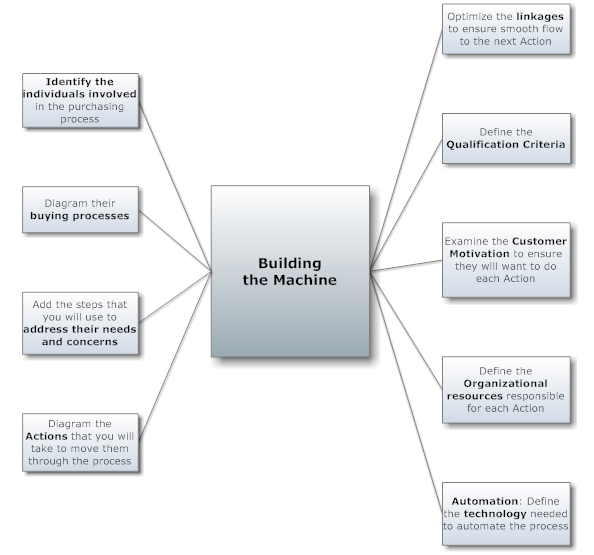
Building the machine involves the following steps:- Identify your buyers
- Diagram their buying processes
- Add to this diagram the steps you will take to address their buying process
- Diagram the Actions you will take to move prospects through the process
- Examine the linkages between Actions to make sure the next steps are obvious
- Define the qualification criteria
- Examine the customer motivations for each Action
- Define the organizational resources responsible for each step
- Define the technology/software that you will use to automate the process
1. Identify your buyers
Start with an intense study of the Customer
If you are like most of the people that I talk to, you already have a sales process, and can show a diagram of the different steps. However most of the time when I work with people to diagnose what is not working as well as they hoped, the problems arise because they have not found a good way to motivate their customer to move forward through a particular step. This happens because they have designed their sales process from their point of view, and not created a customer-centric process. A good way to make sure you are building a sales process that will work for your customers, is to diagram out their buying process. This will help make sure you have appropriate steps in your sales process to address the issues and questions they need answered before they will purchase from you.I recommend starting by identifying the different job functions that are involved in purchasing your product or service. Often your champion may be a business buyer that is interested in your product for how it can improve a particular business function. But they may have to get approval from the IT department before they can make a purchase. And if the size of the purchase is large enough, you may find that you have to deal with the CFO who only cares about the return on investment.
Also if you work through channels, such as VARs or System Integrators, you will want to develop a completely separate sales and marketing process for how you will locate and qualify them, sign them up, and make the productive.
2. Diagram: customer’s buying processes
Once you have each player identified, I recommend diagramming the buying process for each individual. Only when you are armed with this information, can you properly design your own sales and marketing process.The flow chart below was produced using an excellent flow charting program called Smart Draw that I highly recommend for this purpose. I found Samrt Draw after a lot of research and trials of various other products, and it was by far the easiest and fastest. All other tools that I worked with got in the way of thinking through the process, and required me to pencil out the process before trying to use them to document it.
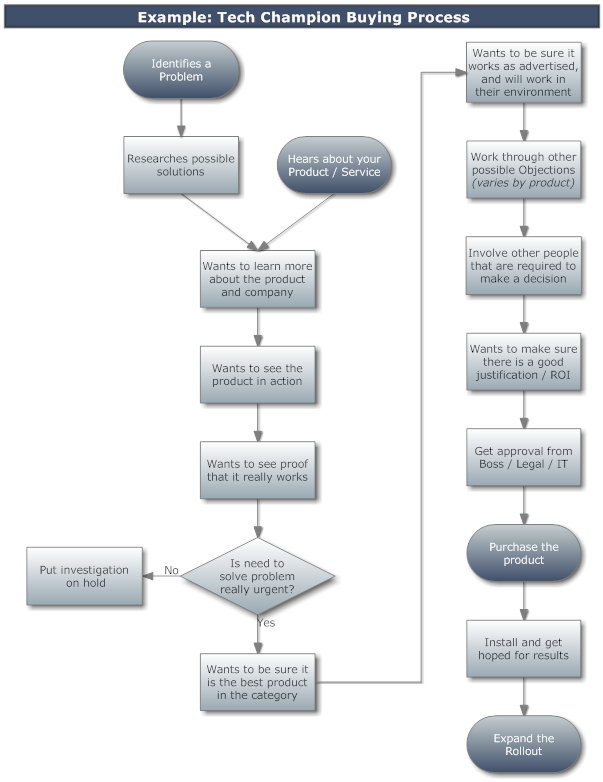
Note that while the above diagram only looks at the main player in the sales cycle, the tech champion, it is important to repeat this step for all other players that are involved in the sales cycle. For example if there is also a business buyer who is the actual decision maker, understanding how they think is going to be important. Or if your sales process involves using resellers or systems integrators, you will want to do a similar diagram for the VAR/SI, thinking about the owner, the reseller sales person who will sell your product, and the technical resource who will demonstrate and install your product.
3. Diagram: add the steps to address the buying process
This next stage involves adding the steps that you can take to address the concerns and needs of the prospect that you identified in the prior stage diagram. Those steps are shown here in the beige color.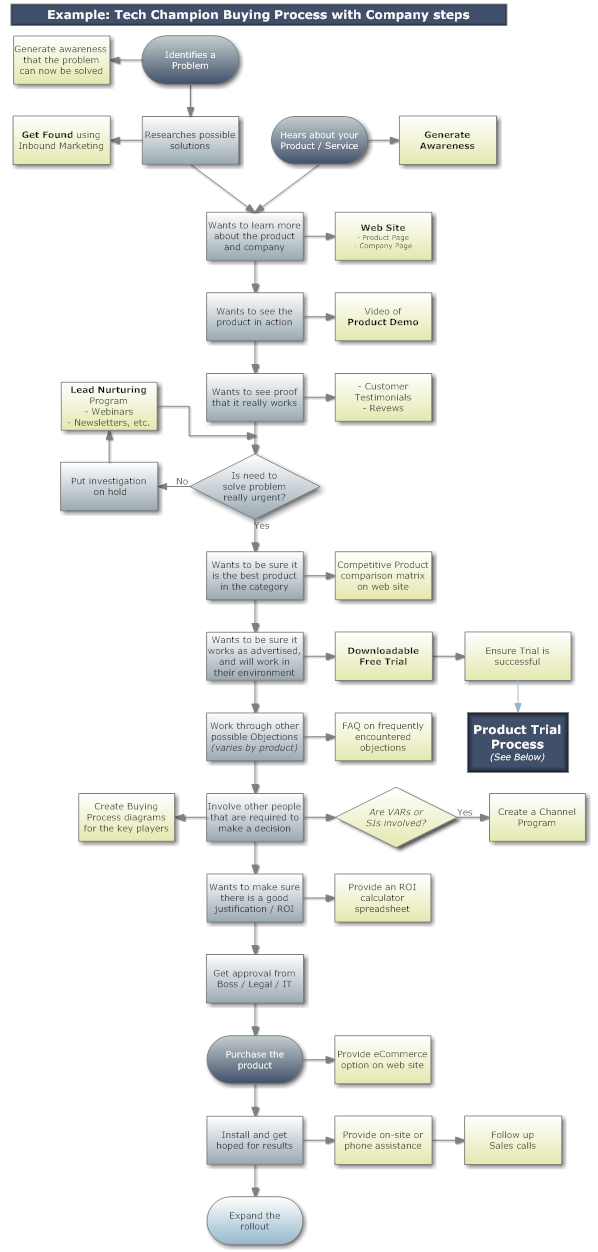
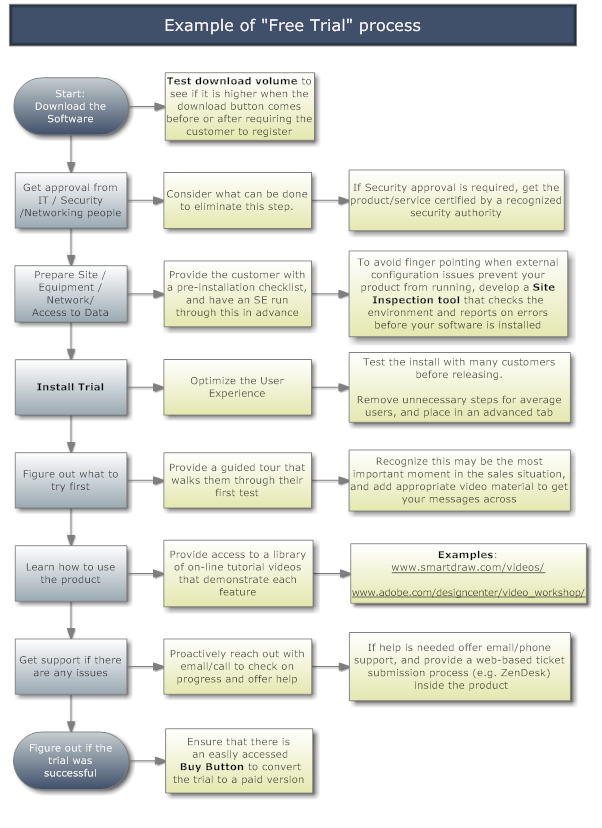
Since the Free Trial has become such an important part of the sales process for many products, I have included a separate sub-process diagram for this here:
4. Diagram Actions to move prospects through the funnel
This step involves creating a diagram showing how you plan to move prospects through your sales process, and is the company-centric view. (The diagrams above are all customer-centric.) Having done the work above, this step should be fairly simple.The concept behind this part of the process is that we are breaking down a complex sales cycle into a smaller set of Actions that should result in movement of the prospect through the sales cycle. Later on when we instrument the machine, we will want to track how many people went through a particular Action, and how many of them were we able to successfully move to the next step (conversion rate).
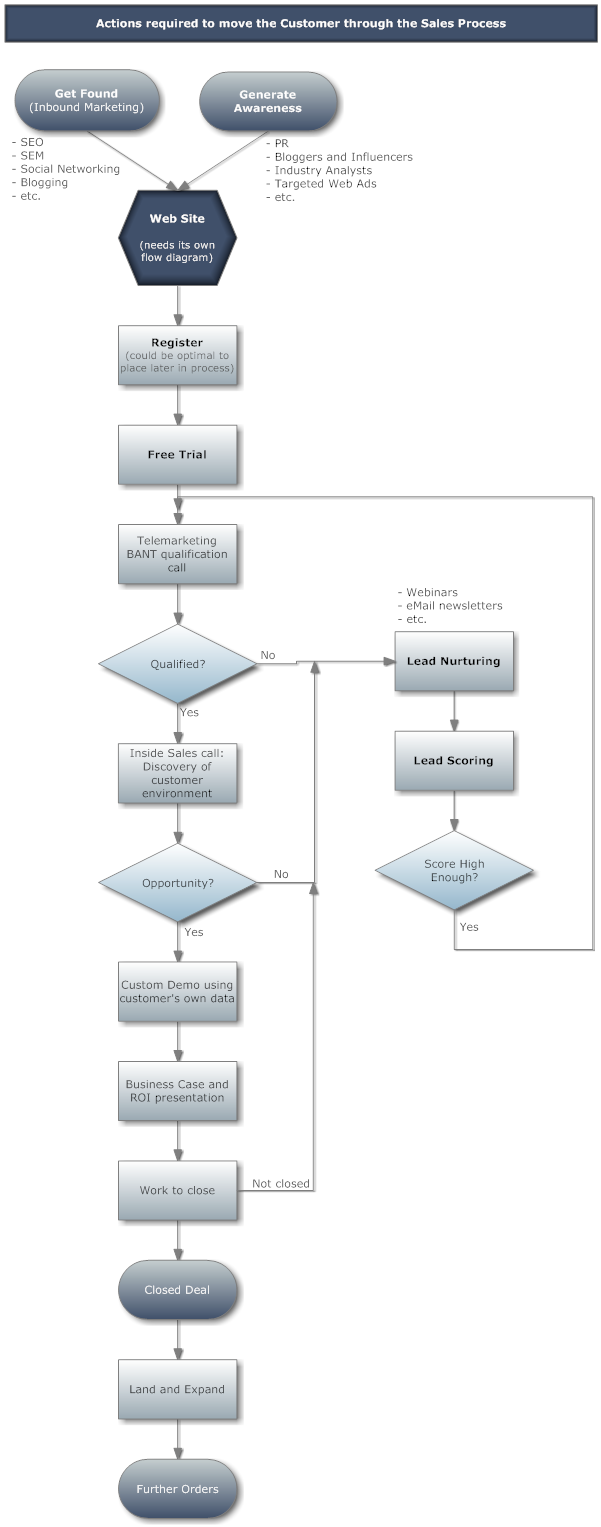
5. Examine Linkages between Actions
The next step is check that there are clearly defined linkages between every action on the diagram, and the following step. One of the most common problems I see is marketing activities that have no clear call-to-action; or no clear step to process the leads after the action is completed.For example, a company will visit a trade show and collect leads. However when they return, no one has thought of how they need to be processed, and as a result they will sit there for many days without being called or emailed.
Another common problem is marketing activities that have no connection to this process. For example, they may sponsor some event, hoping to build brand. But that activity does not result in leads. In my view, not startup can afford to do any kind of marketing activities that doesn’t directly contribute to the process of moving a prospect through to a closed deal.
6. Defining Qualification criteria
Another common problem is no integration between sales and marketing. Sales complains that marketing doesn’t provide them with enough leads, and marketing complains because they gave sales a ton of leads, and sales won’t call them. This happens because there wasn’t a discussion between sales and marketing where they mutually agreed on a clear definition of what represents a Qualified Lead that is acceptable to sales. Getting the lead to that level of qualification (often referred to as a Marketing Qualified Lead or MQL) is the responsibility of the marketing department.To help with qualification, a set of questions are defined. In many cases these are the standard BANT questions (Budget, Authority, Need and Timing). It may also be valuable to ask additional questions that are important to your particular company to make sure they are in your target market. For example: are they a mid-sized company; are they B2B or B2C; are they in a particular vertical; etc. A lead can become an MQL when certain number of these are answered positively.
7. Examine the customer motivations for each Action
This step represents one of the most important and powerful aspects of this methodology. If you started off by looking carefully at your customer’s buying process, you are already beginning to think the right way. But this step takes things further. To this well, you will need to get inside your customers head, and learn to think the way they do.For each Action that you want your customer to do in your sales process, ask the following questions:
- What concerns are they likely to have that will make them not want to take this action?
- What motivations might they have that will make them want to take this action?
To fix this problem, you will need to get inside your customers head and understand their concerns and motivations, and brainstorm a way to provide additional incentive to motivate them to complete the step. For example, offer them something meaningful if they complete your registration. Or find a way to eliminate the need to open the firewall port, and allow them to do the trial in the cloud on your own systems.
There is a lot more discussion on this important topic under the section entitled that comes later.
However, I have found that the most important part in the art of designing a successful sales process lies in this step.
8. Define the organizational resources responsible for each step
This step is simple: for each action you have in your sales process, make sure that there is a clear organizational resource that is focused on that step, and make sure they are measured and incented based on the number of leads they process, and their conversion rates.9. Define the underlying technology and software
Since we want our sales process to be scalable, we need to automate the way that information flows from one step to the other. This requires software or software provided as a service (SaaS). CRM software is a well understood category with Salesforce.com as the dominant vendor that we see in startups. However the are of software for marketing automation is an emerging and rapidly changing area. As of today, there is no one vendor that provides all the tools you are likely to want to use, so you will need to combine several products/services.Interesting areas for marketing products are Inbound Marketing; Social Network monitoring and management; Lead Nurturing and Scoring; eMail marketing; and Web analytics. (This list is not meant to be complete, as this area is evolving fast, and interesting new ideas keep emerging.)
2011年6月29日星期三
High Income Selling Strategies-5 Rules To Govern Your Behavior And Actions In The Sales Cycle–For High Performers
Everyone wants to earn more, but few are willing to change their behavior to do so. In fact, my experience tells me that most aren’t.
Yet, in my 19 years of work with the high sales achiever, I find that those people are different and worth examining. Most of them operate with a different set of rules about selling and the pursuit of new business. These new rules help govern their behavior and actions in the sales cycle. I have over 25 rules that I’ve documented, but here are the top five for you to consider:
1. Define what you want to attract.
High sales achievers are very specific about what they want to attract, both in terms of financial outcomes and business relationships. The Universe has an interesting way of delivering to you exactly what you order, so be specific on your order when you place it. The Universe doesn’t respond well to, “I just want to make more money.”
2. Bring up what scares you.
Most sales executive fears are an illusion. The worst thing we can do with fear is to ignore it. That feeling of fear is trying to tell you something and what it’s telling you is, act on it. If you’re in a sales process and you feel some fear about bringing up a difficult subject, then that’s exactly what you should discuss. Reveal what you feel.
3. Never coerce.
It’s been my privilege to work with some extremely high achievers in the profession of business-to-business sales. One thing I find about them is that they are ‘detached from outcomes.’ They spend no time “convincing, persuading, and defending.” And they spend little time trying to coerce prospects into their way of thinking. When you, a marketing and sales professional, begin to encroach on your prospect’s freedom, you become the pain and they’ll get rid of you. Tell people upfront “it’s alright if you decide this is not a fit at this time, let me know and I’ll be gone.” But do that upfront. That way you’re not 18 months into the process when you hear ‘no.’
4. Think “Process.”
The greatest businesses in the world have the greatest processes in the world. So why should a sales professional be any different? Of all the processes that the high sales achiever has, the most important one is the sales process. A great sales process is one where you can, in a step-by-step fashion, lead people from beginning to end with the constant understanding that some people will qualify “out of the process” and you can move on. Not only should you have a process, but you should also be indignant about the prospect’s adherence to it. (Here’s one of my favorite secrets: Great sales processes are better for the prospect because it helps them identify their problem quicker and create a better solution.) If you feel your sales process is only in your best interest, then you’ve got the wrong process.
5. Think ‘Leverage.’
One way to leverage your strengths is to hire other people and train them to do the things you don’t want to do. But as sales professionals–even as high achieving sellers — you might not have the latitude to go hire staff. But what you can leverage is “current relationships.” High achievers never make cold calls. Why would they? They have learned the power of referral marketing. They find a way to use their current client/network relationships to bring them new, ideal clients.
This is not as simple as “give me ten people you know, so that I can go make a sales call to them.” It is a thoughtful, strategic way to generate enough goodwill with your clients that they beg you to get them introduce you to their friends and associates. A great referral program doesn’t work if you’re not thinking “leverage.”
Yet, in my 19 years of work with the high sales achiever, I find that those people are different and worth examining. Most of them operate with a different set of rules about selling and the pursuit of new business. These new rules help govern their behavior and actions in the sales cycle. I have over 25 rules that I’ve documented, but here are the top five for you to consider:
1. Define what you want to attract.
High sales achievers are very specific about what they want to attract, both in terms of financial outcomes and business relationships. The Universe has an interesting way of delivering to you exactly what you order, so be specific on your order when you place it. The Universe doesn’t respond well to, “I just want to make more money.”
2. Bring up what scares you.
Most sales executive fears are an illusion. The worst thing we can do with fear is to ignore it. That feeling of fear is trying to tell you something and what it’s telling you is, act on it. If you’re in a sales process and you feel some fear about bringing up a difficult subject, then that’s exactly what you should discuss. Reveal what you feel.
3. Never coerce.
It’s been my privilege to work with some extremely high achievers in the profession of business-to-business sales. One thing I find about them is that they are ‘detached from outcomes.’ They spend no time “convincing, persuading, and defending.” And they spend little time trying to coerce prospects into their way of thinking. When you, a marketing and sales professional, begin to encroach on your prospect’s freedom, you become the pain and they’ll get rid of you. Tell people upfront “it’s alright if you decide this is not a fit at this time, let me know and I’ll be gone.” But do that upfront. That way you’re not 18 months into the process when you hear ‘no.’
4. Think “Process.”
The greatest businesses in the world have the greatest processes in the world. So why should a sales professional be any different? Of all the processes that the high sales achiever has, the most important one is the sales process. A great sales process is one where you can, in a step-by-step fashion, lead people from beginning to end with the constant understanding that some people will qualify “out of the process” and you can move on. Not only should you have a process, but you should also be indignant about the prospect’s adherence to it. (Here’s one of my favorite secrets: Great sales processes are better for the prospect because it helps them identify their problem quicker and create a better solution.) If you feel your sales process is only in your best interest, then you’ve got the wrong process.
5. Think ‘Leverage.’
One way to leverage your strengths is to hire other people and train them to do the things you don’t want to do. But as sales professionals–even as high achieving sellers — you might not have the latitude to go hire staff. But what you can leverage is “current relationships.” High achievers never make cold calls. Why would they? They have learned the power of referral marketing. They find a way to use their current client/network relationships to bring them new, ideal clients.
This is not as simple as “give me ten people you know, so that I can go make a sales call to them.” It is a thoughtful, strategic way to generate enough goodwill with your clients that they beg you to get them introduce you to their friends and associates. A great referral program doesn’t work if you’re not thinking “leverage.”
订阅:
博文 (Atom)